
Supervisory Support: Why the Micro-Environment Shapes Employee Effectiveness
This article explores supervisory support as a core job resource that shapes how people experience everyday work. It shows how managers influence the micro-workplace environment through guidance, clarity, and consistency. Drawing on organisational psychology, it explains why effective supervision reduces strain and supports sustainable performance.
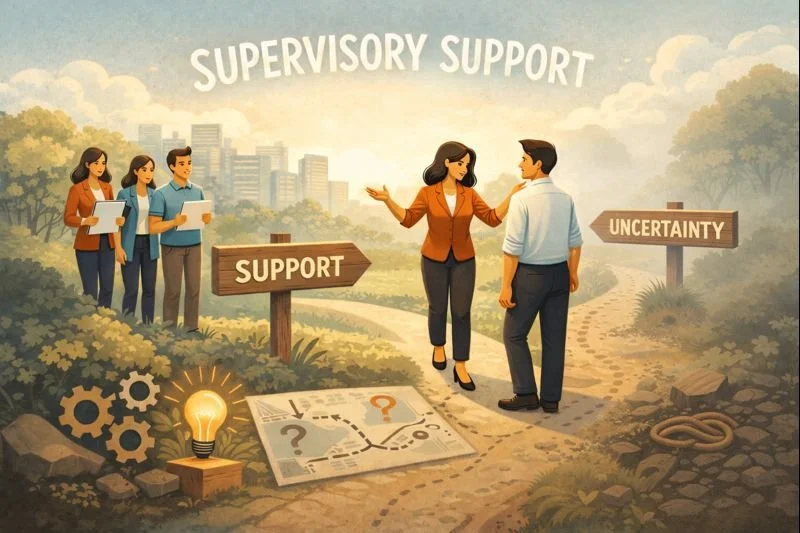
A calm, human-centred illustration showing a manager providing everyday guidance as someone navigates an unclear work path, highlighting support as orientation rather than rescue.
Supervisory support is one of the most influential resources in the workplace, yet it is often spoken about in vague or personal terms. It is sometimes reduced to whether a manager is approachable or well-intentioned. In reality, supervisory support operates at a structural level. It shapes how work is organized, interpreted, and experienced on a daily basis.
In both the Job Demands–Resources model and the Organisational Human Factor Benchmark, supervisory support functions as a key buffering resource. It helps regulate demands, reduce unnecessary strain, and stabilize performance. When support is present, people are better able to cope with complexity and change. When it is absent, even reasonable workloads can become exhausting.
What the OHFB makes explicit is that supervisory support is not a standalone behaviour. It forms part of the micro-workplace environment that line managers directly influence. This micro-environment includes access to job information, clarity of roles, management style, communication practices, and colleague support. Together, these elements determine whether employees feel guided or left to manage uncertainty alone.
In practical terms, this means line managers influence effectiveness through everyday actions. How clearly expectations are explained. Whether priorities are revisited when demands change. How feedback is given. Whether questions are welcomed or subtly discouraged. Whether responsibility is contained or allowed to quietly expand. These are not abstract leadership qualities. They are daily signals that shape how much cognitive and emotional effort employees must expend simply to do their work.
The purpose of measuring these dimensions in the OHFB is diagnostic rather than descriptive. By assessing employee effectiveness outcomes, such as burnout, engagement, and turnover intention, alongside micro-environment support, organisations can determine whether strain is emerging from individual capability or from the immediate work context. This distinction matters because it clarifies accountability. When the micro-environment remains weak over time, employee effectiveness predictably declines.
When supervisory support is limited, people compensate. They spend more time second-guessing decisions, managing risk, and interpreting expectations. Feedback feels personal rather than developmental. Responsibility gradually increases without being formally renegotiated. Over time, this creates strain not because employees lack resilience, but because the system provides insufficient containment.
Strong supervisory support does not remove pressure or lower standards. Instead, it creates steadiness. Supportive managers provide orientation when work becomes ambiguous, consistency when demands shift, and guidance when decisions carry weight. This reduces unnecessary cognitive load and allows effort to be directed toward meaningful work rather than self-protection.
Within the OHFB framework, supervisory support consistently appears as a protective factor for wellbeing and employee effectiveness. Where it is strong, organisations are better able to absorb additional pressures such as change initiatives, increased goals, or higher performance demands. Where it is weak, those same pressures quickly translate into overload, disengagement, or fatigue.
Supervisory support is therefore not a personality trait or a soft leadership preference.
It is a structural job resource, shaped daily by line managers, that determines whether people can sustain performance without burning out.