
Clarity as a Systemic Resource: Why Work Becomes Lighter When Expectations Are Designed Well
This article brings together the different dimensions of clarity explored across the series and positions them within the JD-R model and the Organisational Human Factor Benchmark. It shows how role, communication, boundary, and priority clarity function as interconnected job resources that reduce strain and support wellbeing. Together, they illustrate why clarity must be designed systemically rather than addressed in isolation.
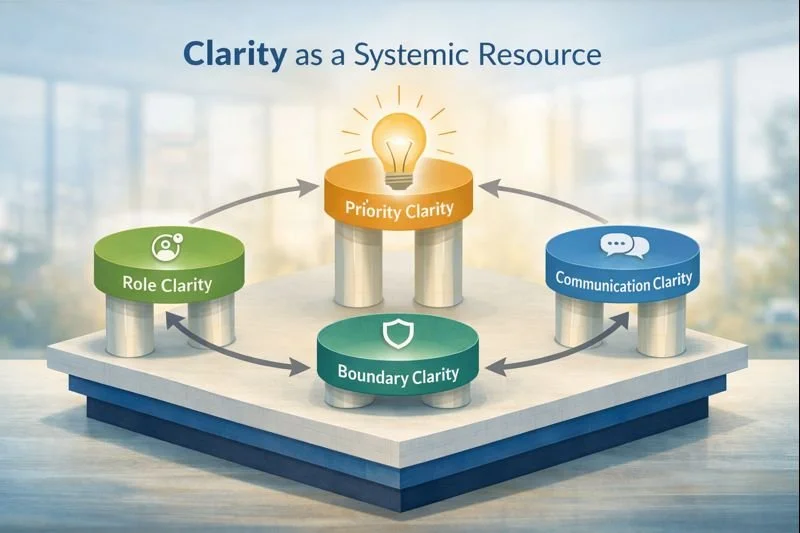
A sage-toned landscape infographic showing role, communication, and boundary clarity feeding into priority clarity as a central, integrative resource.
Across the past few weeks, we have explored clarity from different angles: clarity in roles, priorities, communication, and boundaries. Each of these areas influences how people experience their work, day to day. Together, they form something larger than a set of good practices. They form a system of psychological resources.
The Organisational Human Factor Benchmark is grounded in the Job Demands–Resources model, which explains how stress, burnout, and strain emerge when demands consistently outweigh available resources. In the JD-R framework, resources are the conditions that help people manage demands, remain engaged, and sustain performance over time. Within the OHFB, these same conditions are reflected as protective factors that reduce strain and support wellbeing. Clarity sits at the centre of both frameworks, shaping how work is experienced and managed.
Clarity reduces unnecessary cognitive and emotional load. When people know what is expected of them, what matters most, how to communicate effectively, and where their responsibility begins and ends, they expend less energy on interpretation and self-protection. That energy becomes available for meaningful work.
What is often missed is that clarity is not a single intervention. It is not achieved through a job description alone, or a once-off conversation. It is created through multiple, reinforcing signals across the system. Role clarity supports confidence. Priority clarity protects focus. Communication clarity prevents misunderstanding. Boundary clarity contains overload. When one of these weakens, the others are forced to compensate.
This is why clarity must be treated as an organisational responsibility rather than an individual trait. When systems are unclear, people stretch themselves to make things work. Over time, that stretch becomes strain. No amount of resilience or personal coping can fully compensate for unclear expectations built into the structure of work.
Organisations that invest in clarity tend to see steadier performance and healthier engagement, not because work becomes easier, but because it becomes more navigable. People can direct their effort with intention rather than constantly adjusting to ambiguity.
Seen through this lens, clarity is not about control or rigidity. It is about creating conditions where people can contribute sustainably. It is a foundational resource that allows other resources, such as autonomy, development, and growth, to function effectively.
As this clarity series draws together, the message is simple. When expectations are designed well, work feels lighter. Not because demands disappear, but because people are no longer carrying the hidden cost of uncertainty.
Clarity is not a soft extra.
It is a systemic resource that shapes wellbeing and performance at their core.