
Colleague Support and Team Norms: How Peer Dynamics Shape Strain and Sustainability
An exploration of how colleague support and everyday team norms shape whether work feels shared or silently carried. It looks beyond personalities to the informal rules that govern asking for help, managing uncertainty, and distributing pressure at work. It shows how teams can either buffer strain collectively or allow it to accumulate in individuals over time.
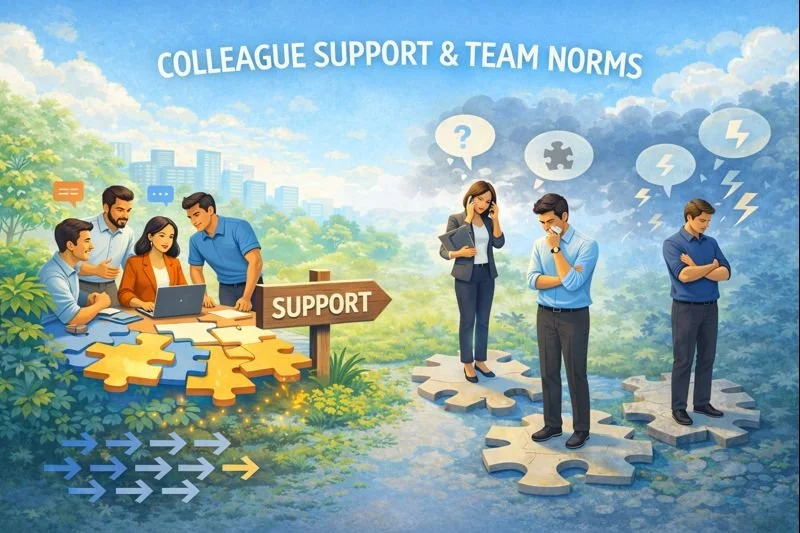
A clean, contemporary illustration showing how strong team norms allow support and clarity to flow between colleagues, while weak norms leave individuals isolated, carrying uncertainty on their own.
Colleague support is often treated as a “nice to have” feature of workplace culture. When teams get along, morale improves. When they do not, conflict arises. While this framing sounds reasonable, it misses a more important point.
Colleague support operates as a job resource, not a social bonus. It shapes how work is shared, how uncertainty is handled, and how much pressure individuals quietly absorb. Over time, team norms either distribute strain across the system or concentrate it in individuals.
From an organisational psychology perspective, peer dynamics form part of the micro-environment employees work within every day. This environment is not defined by formal policies or values statements, but by repeated, informal signals. What happens when someone asks for help. How mistakes are responded to. Whether uncertainty is discussed openly or managed privately. These patterns determine whether people feel supported or exposed.
When colleague support is strong, teams act as informal buffers. Workload is shared more evenly. Information circulates rather than bottlenecks. People check assumptions, sense-test decisions, and step in when pressure increases. Importantly, this does not require close friendships or constant collaboration. It requires norms that make support legitimate rather than risky.
When those norms are weak, the opposite occurs. People hesitate before asking questions. They avoid revealing uncertainty. They manage risk alone rather than collectively. This is not because they lack trust in their colleagues as individuals, but because the team environment has taught them that support is conditional, inconvenient, or costly.
These dynamics matter because most strain does not arise from dramatic events. It accumulates through small, repeated adjustments. Holding back questions. Taking on extra work rather than pushing back. Absorbing ambiguity to avoid appearing incompetent. Each adjustment is manageable in isolation. Over time, they quietly deplete energy.
Team norms also influence how responsibility expands. In the absence of clear peer support, capable employees often compensate. They pick up slack, cover gaps, and keep things moving. While this may be rewarded in the short term, it gradually concentrates responsibility and pressure. What begins as helpfulness becomes overload.
It is important to note that poor colleague support does not always look hostile. In many teams, it appears polite and functional on the surface. People are friendly. Meetings run smoothly. Tasks get done. Yet beneath this surface, norms discourage challenge, uncertainty, or asking for help. Strain accumulates not because people are mistreated, but because they are unsupported in navigating complexity.
Within the Organisational Human Factor Benchmark, colleague support interacts closely with supervisory support, management style, and communication structures. Even strong managers cannot fully compensate for weak peer norms. Likewise, supportive teams can partially buffer inconsistent leadership. This is why peer dynamics matter diagnostically. They help explain why similar roles experience strain differently across teams.
Colleague support, then, is not about harmony or likability.
It is about whether the team environment allows pressure to be shared rather than silently absorbed.
Sustainable performance depends not only on what leaders do, but on what teams make possible for one another.