
Remuneration: Why Fairness Is a Workplace Resource
Remuneration is not experienced as a number, but as a signal of fairness in the relationship between effort and reward. This article explores how perceived fairness shapes motivation, engagement, and the sustainability of performance. When pay aligns with role, contribution, and context, it reinforces the broader system of work.
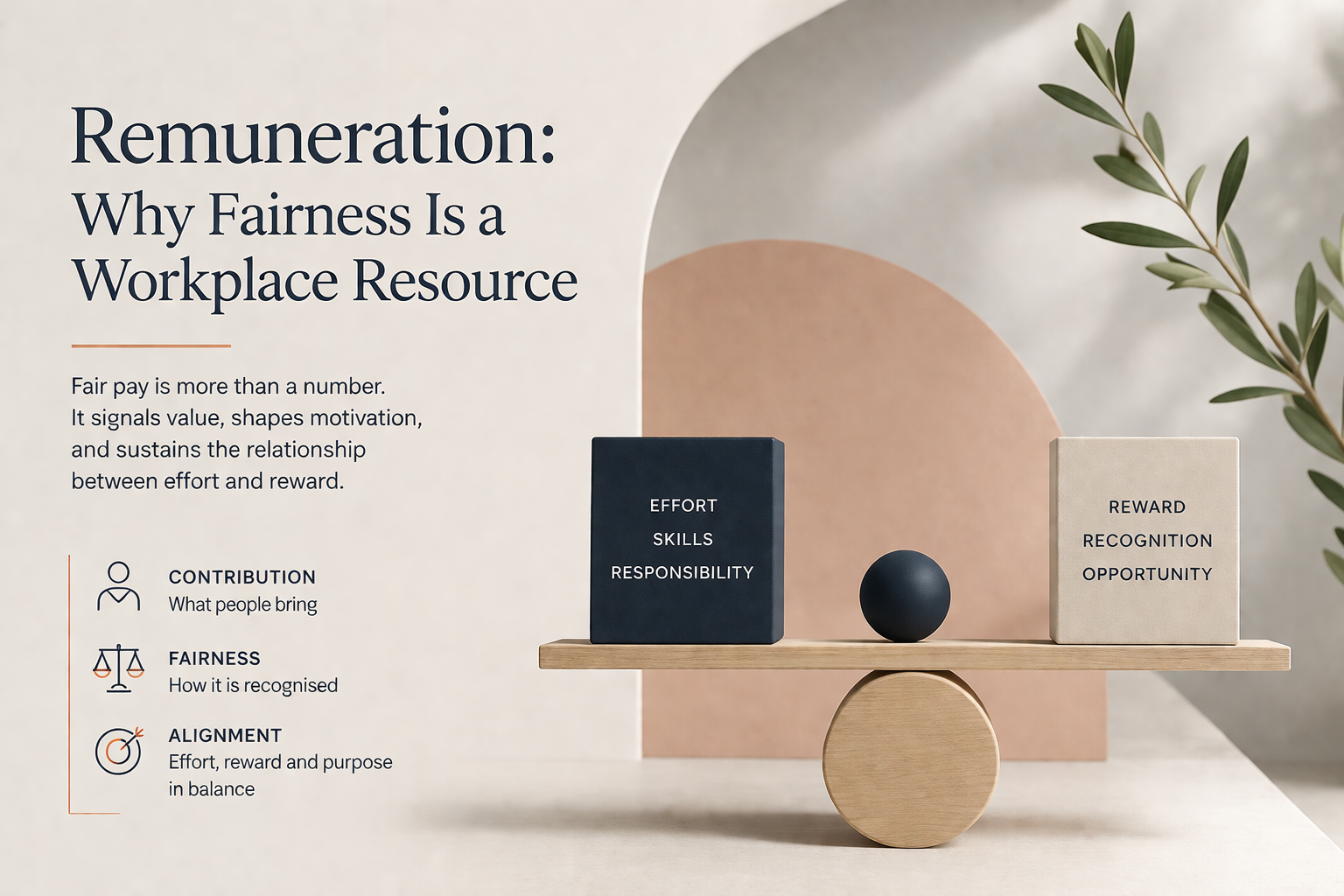
A minimalist composition of balanced stones on a wooden plank, suggesting equilibrium between contribution and reward. The image reflects how remuneration is experienced as a balance between what people give and what they receive.
Workplace performance is often explained through clarity, support, growth, and capability. Organisations invest in defining roles, developing people, and improving systems in an effort to strengthen performance and wellbeing.
Yet another factor sits alongside these, shaping how work is experienced:
remuneration.
Not simply in terms of how much people are paid, but in how fair that pay is perceived to be in relation to their role, their contribution, and the broader system.
This distinction matters because remuneration does not only influence satisfaction. It influences how people interpret the exchange between themselves and their organisation.
Pay is interpreted, not just received
Remuneration is rarely experienced as a neutral transaction.
Employees do not assess pay in isolation. They interpret it in context.
They compare:
their effort with their reward
their role with others
their contribution with recognition
This means that two individuals receiving the same pay may experience it very differently depending on how they understand its fairness.
From a systems perspective, remuneration functions less as an absolute figure and more as a signal.
What pay signals about the organisation
Pay communicates more than compensation.
It signals:
what the organisation values
how different roles are prioritised
how contribution is recognised
When these signals are clear and consistent, remuneration can reinforce alignment between effort and reward.
When they are not, ambiguity emerges.
Employees begin to question:
how decisions are made
whether roles are weighted appropriately
and whether their effort is being recognised accurately
This uncertainty rarely stays contained. It begins to shape motivation and engagement.
The effect of perceived unfairness
When remuneration is experienced as unfair, the impact is often subtle at first.
Employees may:
reduce discretionary effort
become more cautious in how they contribute
or disengage from aspects of the role that feel undervalued
Importantly, this is not always visible as dissatisfaction.
It often appears as a quiet recalibration of effort.
Over time, this affects both performance and the sustainability of work.
Fairness is not the same as equality
One of the challenges in remuneration is that fairness is often confused with equality.
Equal pay for all roles is rarely appropriate. Roles differ in complexity, responsibility, and impact.
Fairness, instead, relates to whether differences in pay are:
understood
justifiable
and consistent with how work is structured
When these elements are clear, variation in remuneration is more likely to be accepted as part of a coherent system.
When they are not, even well-intentioned pay structures can feel arbitrary.
Remuneration within the Job Demands–Resources framework
From a Job Demands–Resources perspective, remuneration functions as a resource when it reinforces the exchange between effort and reward.
When employees perceive that their contribution is recognised appropriately, remuneration supports motivation and engagement.
When that link is unclear or inconsistent, remuneration loses its resource value.
In these conditions, even well-designed roles and supportive environments can struggle to sustain performance.
The role of transparency and consistency
Perceptions of fairness are shaped not only by outcomes, but by how those outcomes are determined.
Employees do not need full visibility into every decision, but they do need:
a sense of how remuneration is structured
consistency in how decisions are applied
and clarity on how their role fits within the broader system
Without this, people rely on informal comparisons and assumptions.
These rarely lead to accurate conclusions, but they strongly influence perception.
Remuneration as part of system design
Like the other elements in this series, remuneration does not sit in isolation.
It interacts with:
role clarity
performance expectations
career pathways
and organisational structure
When these elements are aligned, remuneration reinforces the system.
When they are not, pay can feel disconnected from the work itself.
This disconnect is often where frustration emerges, not because of the amount, but because of the lack of alignment.
A different way to think about pay
Organisations often approach remuneration as a financial or administrative decision.
But from a workplace design perspective, it is also a psychological one.
The question is not only:
“Are we paying competitively?”
It is:
“Does our remuneration structure make sense in the context of the work we are asking people to do?”
This shifts the focus from benchmarking alone to alignment.
Why this matters
When remuneration is experienced as fair, it stabilises the relationship between effort and reward.
Employees are more likely to:
sustain effort
engage with their roles
and invest in their work over time
When it is not, the opposite occurs.
Even in environments with strong clarity, support, and development, perceived unfairness can quietly erode the system.
Closing
Remuneration is often treated as a separate conversation from job design.
In practice, it is deeply connected.
It shapes how people interpret their roles, their contribution, and their relationship with the organisation.
Understanding fairness as a workplace resource shifts the focus away from pay as a number, and toward pay as part of a broader system of work.